This is an honest, unfiltered and deeply personal account on moving back to my home country India after almost two decades of living abroad. This post has come about about after much reflection. I admit to feeling uncertain about sharing my sentiments on such a public platform, where anything I express can be subjected to scrutiny and judgment. But blogging has been an essential part of my life way before I even became a mother, and I have revealed so much about my journey on this platform so far. It felt insincere to gloss over such a significant life event.
For those unfamiliar with my background, to provide additional context, I am someone who has had global exposure from the time I entered this world.
Born in Oldham, a town in Greater Manchester, I spent my early childhood in Sutton and Wolverhampton in England. When my cardiologist father was offered a job in the Middle East, our family moved to Saudi Arabia for a few years followed by Bahrain where I attended a British International school with children from different nationalities and backgrounds. After the Gulf War broke out, we moved back to England where I attended school briefly.
 |
| Early childhood in UK |
 |
| St. Christopher's School, Bahrain |
My parents made the decision to permanently relocate to India when I was an eight-year-old with pigtails and missing teeth. They built their forever home in my beloved hometown of Mysuru in the state of Karnataka and reside there to this day.
Even after moving to India, my siblings and I had several opportunities to travel not only within the country but also overseas during the summer holidays courtesy of our wanderlust parents.
After my graduation and marriage in India, I pursued my higher education in Singapore and worked there for more than a decade. During my time in the sunny island nation, I crossed paths with people from diverse cultures and walks of life, gaining invaluable life lessons along the way. As a young married couple, Singapore also served as an excellent base for us to travel which further ignited a spirit of adventure and fuelled personal growth.
 |
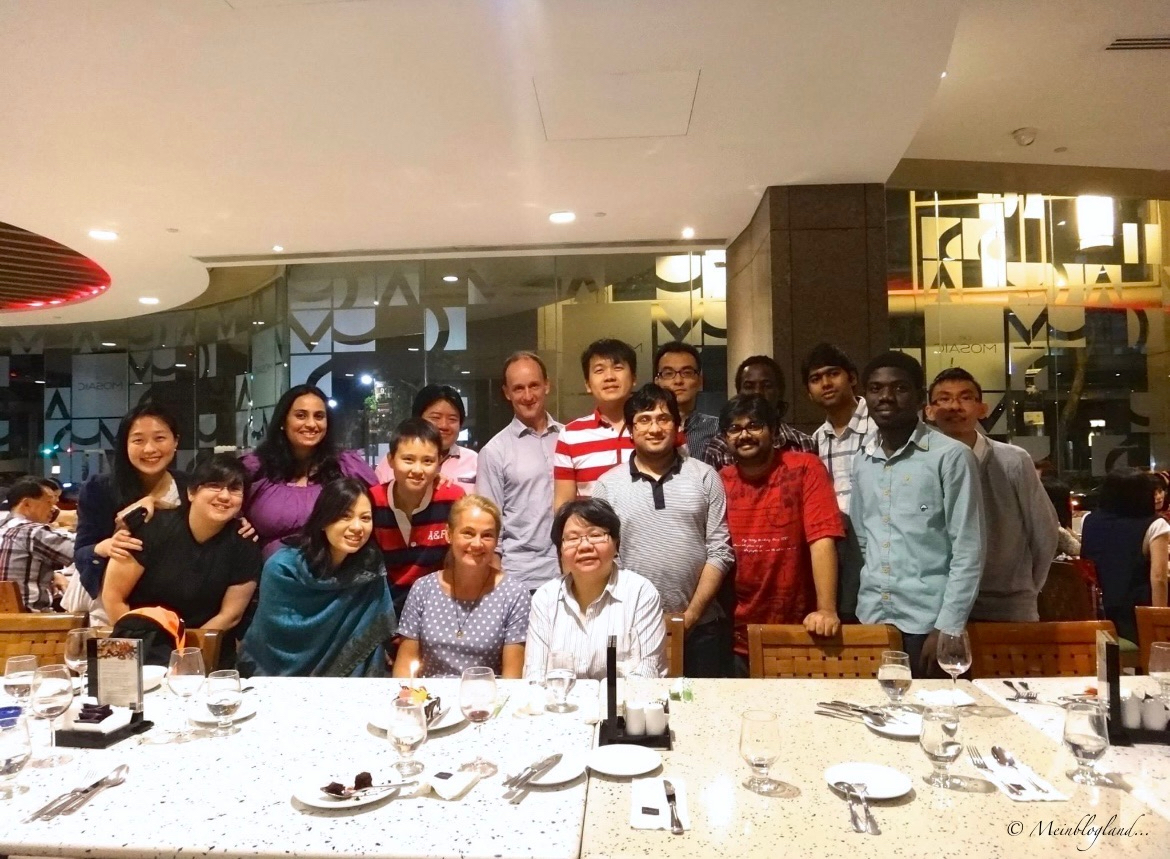
| NUS lab colleagues, Singapore |
 |
| NTU lab colleagues, Singapore |
Here's the thing - I feel like if given an opportunity to live abroad, even briefly, one ought to take it. Living abroad can bestow a more well-rounded perception of the world, can certainly improve one's career prospects, provide a higher quality of life and contribute to financial gain. However, in my opinion, these are not the sole reasons, nor the most significant.
Growing up in India as a preteen, teen and young adult, I never realised it then, but years later observed that many Indian children from an upper-middle-class to affluent backgrounds tend to be rather entitled. This entitlement often stems from their parents taking charge of most aspects of their lives, along with the option to outsource many tasks to ease daily living. And Indian parents don't just stop with their children; most of them continue the trend of selfless devotion towards their grandchildren as well. As convenient as that may be, living in such an environment lifelong can create a cycle of dependency, hindering the discovery of one's true capabilities.
On the other hand, residing abroad entails stepping out of one's comfort zone and out of the protective shadow of the familiar support system. This experience compels individuals to develop patience, independence, self-discovery, problem-solving, responsibility and adaptability. It teaches valuable life skills, builds character and bestows a profound lesson in not taking anything in life for granted. Having lived abroad for many years, my husband and I have become adept at running our household, have become well-versed in all types of cleaning, cooking, repair, DIY projects, caring for our children, handling our careers and finances, managing our social life and pursuing our hobbies—all without an entourage of hired help. I don't know about anyone else but to me, self-reliance is priceless. Looking back, if given the chance for a do-over, I wouldn't change a thing 😊
Now, coming to the purpose of this post - after 17 years of living in Singapore, when I revealed our plans of moving back to India to family, friends and co-workers, I was met with a variety of responses, and frankly, most of them were not positive. Even though I didn't owe anyone an explanation, I didn't have a single clear-cut answer to the question of why we wanted to move back. It was a complex sentiment to articulate and so I decided that I would answer that question through my blog and when the timing was appropriate.
Almost immediately after our relocation, I fielded numerous enquiries, not only by friends and family but also strangers on social media about how I was feeling about the move. I realized that there were a lot of Indians who were in the same boat as we had been, contemplating a move back but were unsure of what to expect and hence, naturally curious. At the time, I thought it was a premature question because we were still settling into our new life and with so many things demanding our attention, I wasn't in the headspace to dissect my feelings.
A year prior to the move, we had embarked on an extensive renovation of the first and second floors of my in-laws' 35-year-old house in Bengaluru, a project far from completion when we arrived. Our foremost priority was to finish and furnish the new extension according to our vision. We also had to patiently wait several weeks to receive our Singapore cargo, and unpacking the contents of our past life turned out to be quite time-consuming and labor-intensive. Ensuring a smooth transition for our twin daughters into their new school and planning my husband's transfer to his company in India were also top priorities. Then there were the unavoidable formalities that most returning Indians are familiar with - bank-related tasks, insurance, setting up bill payments, updating contact details, children's Aadhaar cards among others. We were simultaneously getting the remaining undertakings done for our house - security system installation, home automation and landscaping. Once those were sorted, I had to face the daunting challenge of overcoming one of my greatest fears – driving in Bengaluru! Obtaining my driver's license became a necessary step in addressing this fear. And despite my decision to temporarily step back from my career, I still needed to explore potential options which has kept me on my toes for the past few months. With all this going on, reflecting on the various aspects of my life post-relocation would require time and effort. Now, more than a year into our life in India, I am ready to share my thoughts on the journey so far.
Right off the bat, let me tell you that I am not uninformed or delusional. Yes, I am highly aware of the problems that still plague India. The population density, the pollution, the corruption, bureaucracy, nepotism, reservation, the economic inequality, the traffic, issues of women's safety, the poor sanitation, the appalling lack of civic sense among others. As a stark contrast to India's burgeoning digital infrastructure is the physical infrastructure which is woefully inadequate. There is absolutely no denying that these are crucial factors when one considers the quality of life in a country.
But let me also tell you that India was my home through the ages of eight to twenty-four and I genuinely love my country, even with its myriad issues. I never wanted to 'escape' from India, nor did I align with the kind of NRIs (Non Resident Indians, for the uninitiated) who perpetuate the conviction of living their best life while dissing their motherland at every given opportunity. To me, gratitude towards a adoptive land does not equate to rejection of the motherland. I recognise my relative privilege (I thank my lucky stars for it even!) and wholly acknowledge that I had a wonderful childhood in India where I lived a life of comfort, was provided with a good education and raised with upstanding values imbibed from my culture and faith. The friendships I forged in India are the ones that have withstood the test of time. Along with my upbringing, my country has shaped my identity and contributed to who I am today. Possessing fierce loyalty as a personality trait, I am not inclined to disregard this reality of my life.
 |
| Good old college days |
Also, it is of significance to note that India is a rapidly growing, diverse economy and a country that has age on its side (at the time of writing this piece, ~65% of the population is under the age of 35). India has been transforming, and these changes are not only visible and palpable but impactful as well. Anyone who cannot see that or tells you any different is either wilfully ignorant or blind! I can personally attest to the fact that the India of 2024 is very different from the India of 2004.
Please understand that this post isn't meant to throw shade on anyone's life choices or ignite any debates. There is no right or wrong path in life (unless you are involved in something illegal 😛). Each individual has different aspirations and perspectives; every family has different priorities and motivations. What works for one, may not work for the other. My choice to relocate to my homeland simply feels more aligned with who I am at this point in my life. You can choose to disagree with everything I have said in this post, and I promise I will respect that. Let's just agree on one thing - to each live our lives the way we see fit. Or as Gen Z would succinctly put it, "you do you" 😄
These are some of the reasons why we left Singapore (SG for short) and moved to India,